
How to Become a Martial Arts Instructor: Steps, Costs & Pay


There is no national license or exam to teach martial arts in the US. That sounds freeing, but it is exactly why the path confuses people: nobody hands you a checklist, so you can spend years training without knowing what a school owner or a parent will actually ask for.
To become a martial arts instructor, train in one style until you reach black belt or the equivalent, start assisting in classes at your school, earn an instructor certification from your school or style's association, get CPR and First Aid certified, pass a background check, and build supervised teaching hours before leading your own classes.
Below we cover each step, what the credentials cost, how long it takes by style, the different ways instructors get paid, and how to go independent when you are ready.
What does a martial arts instructor do?
A martial arts instructor leads group classes, usually built around a warm-up, technique work, drills, sparring or rolling, and a cool-down. On top of that, most instructors run belt or rank testing, coach students who compete, and teach private lessons.
In a small school, the job rarely stops at the mat. Instructors often greet trial students, answer parent questions before and after class, take attendance, and sometimes chase late tuition. The more of this you can handle calmly, the more useful you are to a school owner.
Titles vary from school to school, but the usual ladder looks like this:
- Assistant instructor: helps run classes, holds pads, corrects beginners, and leads warm-ups.
- Instructor: leads their own classes, often beginners or kids to start.
- Head or chief instructor: sets the curriculum, runs gradings, and trains the other instructors.
- Program director: manages a school's programs, staff and enrollment, often with a sales target.
- School owner: does all of the above plus the business.
The teaching itself is a skill you learn separately from the martial art. Our guide on how to run a martial arts class breaks down class structure and room management in detail.
Do you need a license, a degree, or a black belt?
License
There is no federal license to teach martial arts, and states generally don't license martial arts instructors the way they license teachers or personal care workers. If you open your own school, you will still need the normal business licenses and local permits, but that is about the business, not your right to teach.
Degree
You don't need a college degree. A high school diploma or equivalent is enough for almost every instructor job. Degrees in physical education, exercise science or education help with teaching method, and a business course is the most useful extra if you plan to run a school one day. The US government's O*NET database files "Martial Arts Instructor" under Self-Enrichment Teachers, alongside dance and music teachers, not under licensed professions.
Black belt
A black belt is the usual bar for leading classes in belted styles like karate, taekwondo, judo and Brazilian jiu-jitsu. It is not the bar for starting to teach. Many schools have students assisting from brown belt or earlier, and some make teaching hours part of the black belt requirement itself.
Non-belted styles work differently. Muay Thai, boxing and MMA coaches earn their place through years of training, fighting or cornering fighters, and the head coach's say-so. Some systems, such as krav maga and several Filipino martial arts, use levels and dedicated instructor courses instead of belts.
What parents and employers actually check is a short list: your rank and lineage (who promoted you), how long you have taught, your safety certifications, a background check, and whether you are insured. The next section turns that list into a checklist with costs.
The instructor credential stack
Since there is no license, these six items are what make you hireable. Very few instructors need every one on day one, but a head instructor or a parents' group will eventually ask about all of them.
| Credential | Why it matters | Who issues it | Typical cost |
|---|---|---|---|
| Rank and lineage (black belt or equivalent) | The main proof of skill and who vouches for you | Your instructor, school or style association | Testing fees set by your school |
| Instructor certification | Shows you have been taught how to teach, not just how to fight | Your school, style association or governing body | $0 in-house to several hundred dollars |
| CPR, First Aid and AED | Expected by employers and insurers | American Red Cross, American Heart Association and other providers | Usually under $150 per course, varies by location and format |
| Background check | Essential if you teach minors | Your employer or your governing body's screening vendor | Usually tens of dollars, often paid by the school |
| SafeSport Trained (where required) | Required by Olympic-sport governing bodies for adults with regular contact with minors | U.S. Center for SafeSport | $20, or free through a governing body; renew every year |
| Liability insurance | Covers injury claims when you teach independently | Specialist martial arts and fitness insurers | About $150 to $750 a year for an individual instructor policy |
The Bureau of Labor Statistics notes that most fitness trainers and instructors need CPR, first aid and AED certification. Martial arts schools expect the same, and it is one of the cheapest items on the list, so get it early.
Teaching kids? Background checks and SafeSport
A large share of martial arts students in the US are children, so this part matters more than most guides admit. Many private schools aren't legally required to background-check staff, which is exactly why parents ask about it. Expect a good school to screen you, and if it doesn't, get checked anyway.
If your school or style sits under an Olympic-sport national governing body, such as USA Taekwondo or USA Judo, SafeSport training applies to you. The SafeSport Trained Core course takes about 90 minutes and costs $20, or nothing if you train through a governing body. The certificate lasts one year, followed by a shorter refresher course each year after.
Ratios matter too. A common rule of thumb is around one instructor per 12 children under 12, with fewer children per instructor for the youngest groups.
Style association certifications
Associations and governing bodies each run their own instructor or coach pathways. A few examples, to show the range (these are examples, not endorsements):
- USA Taekwondo: coaches progress through a coach education program. The Level 2 coach seminar costs $630 and requires current membership, a background check within the past two years, SafeSport certification, the Associate Coach Quiz and the Level 1 seminar.
- IBJJF (Brazilian jiu-jitsu): registering your black belt with the IBJJF costs $400 the first time and $150 for each renewal or degree update, and requires an active membership. Many BJJ instructors never register, but it matters if you want to coach at IBJJF events.
- AAU Karate: runs a coaches course for people coaching athletes at its tournaments.
- Krav maga systems: most run multi-day instructor courses that open once you have reached a set level, with periodic recertification.
Beware "certified instructor" courses with no rank behind them
Online instructor certifications exist, and some teach useful things like lesson planning and class safety. They supplement years on the mat under a qualified instructor. They don't replace them. A parent or school owner will look past the certificate to who promoted you and how long you trained, so treat any course that promises "instructor status" without rank with suspicion.
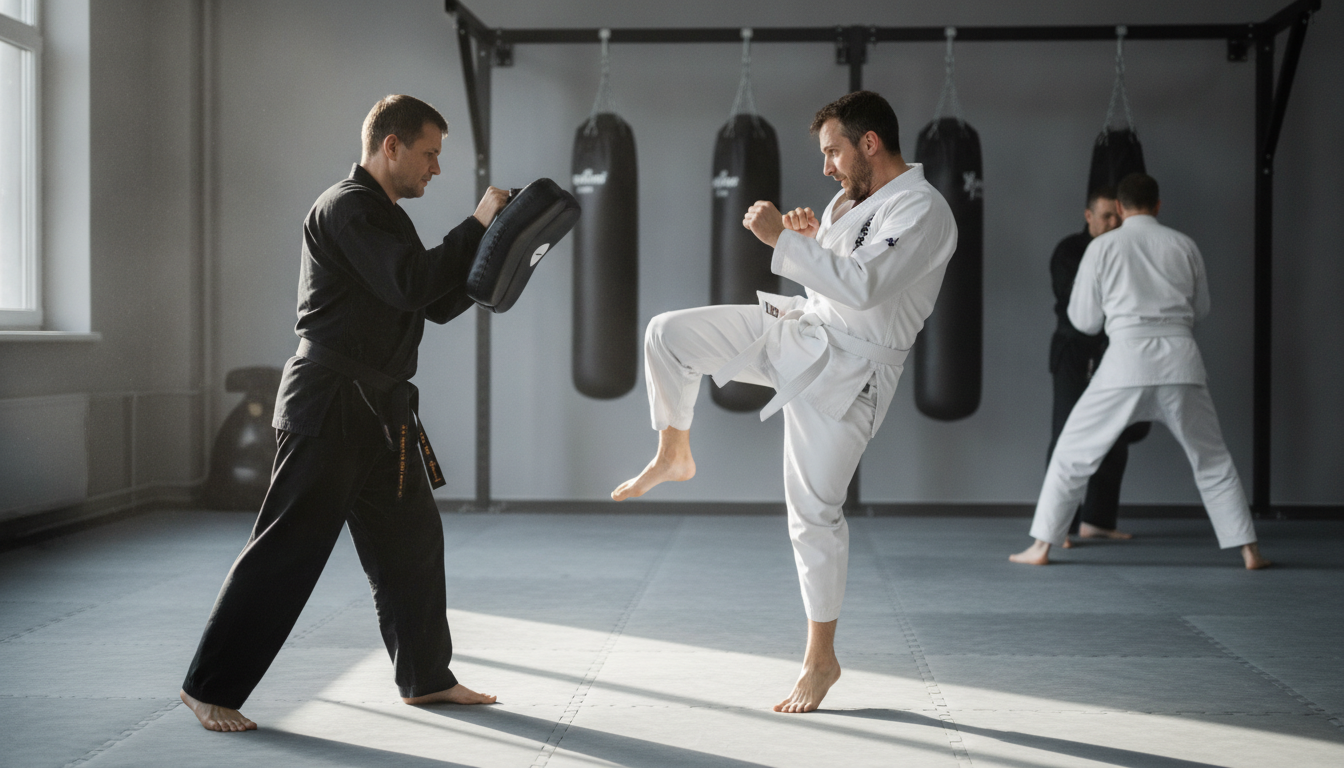
How long does it take to become a martial arts instructor?
It depends heavily on the style and how often you train. Training twice a week versus four or more times a week can change these numbers by years. Treat the ranges below as typical, not guaranteed.
| Style | Typical time to black belt or equivalent | When people usually start assisting | Who recognizes rank |
|---|---|---|---|
| Karate | 3 to 5 years | Brown belt, around 2 to 3 years in | Your school and style federation |
| Taekwondo | 3 to 5 years | Red or brown belt | Your school, Kukkiwon, USA Taekwondo |
| Brazilian jiu-jitsu | 8 to 12+ years | Purple or brown belt, often teaching kids or fundamentals | Your professor; IBJJF registration is optional |
| Judo | Commonly 4 to 6 years to first-degree black belt | Brown belt | National judo organizations such as USA Judo |
| Muay Thai, kickboxing, boxing | No belts; 3 to 5+ years of training or fighting is typical before coaching | When the head coach invites you | Your head coach, plus optional coaching courses |
| Krav maga | Level-based; instructor courses open after a set level | After reaching the required level | The system's organization |
In every style, you usually start helping out well before black belt, and the teaching hours you build during those years are what make you ready to lead a class on your own once you get there.
In total, most people spend 3 to 6 years between their first class and being paid to teach in belted striking arts like karate and taekwondo. BJJ takes longer to reach black belt, although many BJJ schools pay purple and brown belts to teach kids and fundamentals classes well before that.
Step-by-step: how to become a martial arts instructor
1. Pick one style and a school with a real teaching pathway
Your school matters as much as your style. Before you commit, ask the head instructor whether they run an assistant or leadership program, whether assistants get paid or train for free, and whether they certify instructors themselves. A school with a clear pathway will tell you exactly what to do. A school without one may leave you waiting for years.
Lineage matters too. Your rank will always be judged by who promoted you, so choose a school whose head instructor is well regarded in the style.
2. Train consistently and earn rank
Train three or more times a week if you can. Consistency is what moves the timeline in the table above, far more than talent. Test or grade on schedule, and compete if your style has competition, since it sharpens technique under pressure and gives you something to talk about with students who compete.
Cross-training in a second style is valuable later. Early on, it usually slows your progress in the one that will qualify you to teach.
3. Start assisting classes
Tell your instructor you want to teach. Most will start you on simple jobs: holding pads, running warm-ups, partnering with a nervous beginner, or helping a younger kid tie their belt. Many schools make assisting part of the black belt requirement, so you may be asked before you volunteer.
Keep a log of every class you assist: date, class type, and what you did. When you apply for a paid role, "I've assisted 150 kids classes over two years" is far more convincing than "I've helped out a bit."
4. Learn to teach, not just do
Being good at a technique and being able to teach it are separate skills. Practice planning a 45-minute class, managing a room of 15 children, adapting drills for an adult with a bad knee, and giving one correction at a time instead of five.
Borrow structure while you learn. Our martial arts lesson plans give you ready-made class plans by level, and a stock of martial arts drills for kids keeps younger classes moving when attention drops.
5. Earn an instructor certification
Once you are close to black belt, ask about an instructor certification. Many schools run their own in-house program, and style associations and governing bodies run formal pathways like the ones in the credential stack above. An in-house certificate from a respected school is often all an employer needs, while association credentials matter more if you want to coach at their events.
6. Get safety-certified and screened
Get CPR, First Aid and AED certified, and keep it current. Pass a background check, and complete SafeSport training if your school or style falls under an Olympic-sport governing body. The CDC's free HEADS UP online concussion training for coaches takes under an hour and is worth doing if you will teach sparring or throws to young people.
If you teach anywhere outside your home school's policy, get your own liability insurance and have students sign a health and liability waiver. Our health disclaimer examples for fitness class instructors give you wording for the health section.
7. Lead supervised classes, then your own
The usual next step is leading a beginners or kids class with the head instructor watching or teaching nearby. Ask for feedback after each one. Once they trust you with the room, you'll get your own regular time slot, and that is the point where most instructors start being paid.
8. Find paid work
Start with your own school, since it already knows you. Beyond that, look at:
- Other martial arts schools in your area, especially ones growing their kids programs.
- YMCAs and community centers.
- Parks and recreation departments, many of which hire contract instructors to run classes.
- After-school programs and summer camps that want an enrichment activity.
- Private lessons for adults and kids who want one-to-one attention.
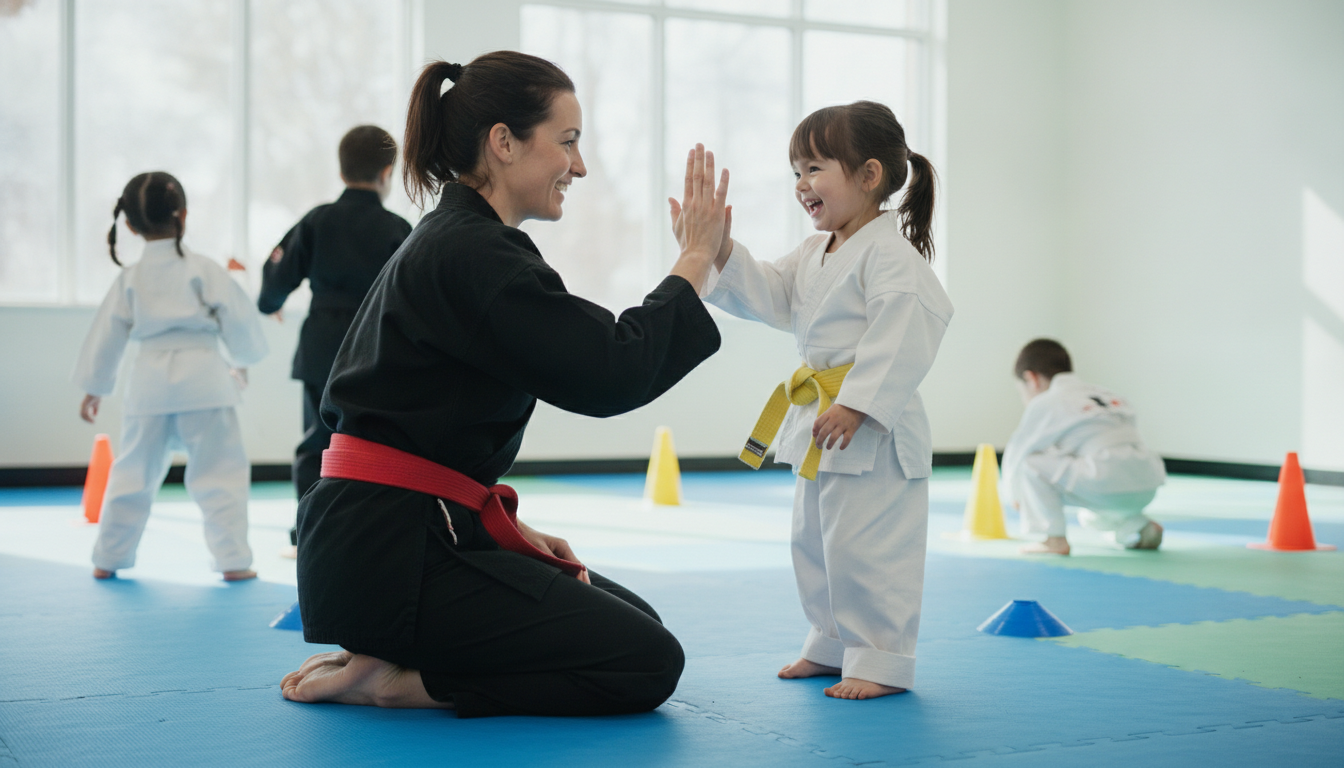
How much do martial arts instructors make?
Start with government data, since it is the most reliable. O*NET lists "Martial Arts Instructor" as a job title under Self-Enrichment Teachers, with a median wage of $22.50 an hour, or $46,800 a year (2025). The closely related fitness trainers and instructors category has a median of $47,160 a year (May 2025), with the lowest 10% earning under $28,800 and the top 10% over $83,100.
Why salary numbers online disagree
Search for martial arts instructor salaries and you'll find figures anywhere from about $30,000 to over $90,000. The gap comes from two things. First, most instructors teach part-time, on weekday evenings and Saturdays, so an annual salary figure says little about what a typical instructor takes home. Hourly or per-class pay is a better guide. Second, job-board averages mix assistants, head instructors and school owners into one number, and owners' income depends on enrollment, not a wage.
The seven ways instructors get paid
| How you're paid | Typical arrangement | Typical rate |
|---|---|---|
| Free tuition in exchange for teaching | Common for assistants and junior black belts | Value of your tuition, typically around $100 to $200 a month |
| Per class | Senior assistants and instructors | Roughly $15 to $40 per class-hour |
| Hourly staff | Staff instructors at larger schools | About $15 to $30 an hour, around a $22.50 median |
| Salaried head instructor or program director | Full-time, often with sales and admin duties | Roughly $30,000 to $60,000 a year |
| Contract instructor with parks and recreation | You teach; the city registers students and promotes the class | A share of course revenue, often 70% to you |
| Program inside a host gym | You bring the students; the gym provides the space | Revenue share, commonly around 70/30 in your favor |
| Private lessons | One-to-one or small group | Roughly $30 to $80+ per session, more for well-known instructors |
The rates above are typical ranges from owners and hiring guides rather than formal surveys, so check them against your local market. The parks and recreation split is well documented: the City of Tampa's contract instructor manual pays instructors 70% of course revenue in staffed indoor facilities and 80% in outdoor or unstaffed ones.
Here's how that adds up for a part-time instructor. Teaching eight class-hours a week at $25, plus three private lessons at $60, comes to $380 a week, or roughly $19,000 a year. A single parks and rec class with 15 kids paying $120 for an eight-week session, on a 70% split, pays $1,260 per session. These are illustrative numbers, but they show why many instructors combine two or three pay models.
What raises your pay: higher rank, strong kids-class skills (where much of the enrollment is), the ability to turn trial students into members, competition results, and eventually running your own program.
Teaching kids vs. teaching adults
Most instructors teach both, but the classes feel like different jobs.
| Kids classes | Adult classes | |
|---|---|---|
| Class length | 30 to 45 minutes for young children | 60 to 90 minutes |
| Main focus | Games, attention, listening, basic technique | Technique, conditioning, sparring or rolling |
| Who you communicate with | Parents, before and after every class | The student directly |
| Safety priorities | Ratios, background checks, SafeSport where required | Injury history, controlled contact, consent for partner work |
| What makes you valuable | Keeping 15 kids engaged and parents happy | Technical depth and a welcoming beginners' experience |
At many schools, kids programs bring in the majority of revenue, which makes kids-teaching skill the fastest route to paid hours. Part of that skill is talking to parents about what their child gets from training, and our piece on the benefits of martial arts for kids covers what families are hoping for. Adult programs are a strong market too, though. BJJ, Muay Thai, fitness kickboxing and self-defense classes attract adult beginners in their 30s, 40s and beyond, and they pay per class at similar rates. Being able to teach both makes you the easiest person on the schedule to hire.
Your path from student to paid instructor
Here is a realistic year-by-year sequence for a belted striking art like karate or taekwondo. Stretch it by several years for BJJ.
- Years 1 to 2: Train three or more times a week. Get CPR and First Aid certified early. Tell your instructor you want to teach eventually.
- Years 2 to 3: Assist kids and beginner classes. Log your hours. Ask to sit in while the head instructor plans lessons and gradings.
- Years 3 to 5: Earn your black belt and an instructor certification. Complete a background check and SafeSport training if it applies. Lead supervised classes, then start per-class paid work.
- Year 5 onward: Move into a head instructor role, pick up contract work, or start your own program.
Before you commit years to a school, ask the owner five questions:
- Do you have an assistant or leadership program?
- Are assistants paid, or do they train for free?
- Who certifies instructors here, and what does it involve?
- Is there a non-compete in the instructor agreement?
- What is the path from assistant to running my own class?
From instructor to running your own program
Once you have a following of students, you have more options than teaching for someone else. The common next steps are running a class in rented space or inside a host gym on a revenue share, taking a parks and recreation contract, adding after-school program classes, and eventually opening your own school.
Before you branch out, check any non-compete in your agreement and keep good relations with your home school. Many instructors open with their original instructor's blessing and stay affiliated for years. Our guide on how to start a martial arts school walks through every step from rented hours to a leased space, and a martial arts business plan helps you test the numbers before you sign anything. You'll also need your own cover, so read our guide to martial arts school insurance before your first class. Once you're running, our tactics for how to promote a martial arts school help you fill the mat.
What changes most is the admin. Suddenly you handle trial bookings, payments, waivers, attendance and parent emails as well as the teaching. We built Pembee so independent instructors can take bookings and payments for trial classes, intro courses and memberships, keep family accounts and attendance in one place, and email a whole class in one click. You can see how it works on our martial arts software page, or compare options in our roundup of the best martial arts software.
Key takeaways
- There is no federal license to teach martial arts. Rank, lineage, teaching hours and safety credentials are what make you hireable.
- The core credential stack is rank, an instructor certification, CPR and First Aid, a background check, SafeSport where required, and insurance if you teach independently. SafeSport costs $20 or less.
- Expect 3 to 6 years from first class to paid teaching in karate or taekwondo, and longer in BJJ.
- Most instructors are part-time. The median for martial arts and similar self-enrichment teachers is $22.50 an hour, and many combine per-class pay, privates and contract work.
- Kids-class skill is the fastest route to paid hours, and your own program is where the earning ceiling rises.
FAQs
Can you teach martial arts without a black belt?
Yes, as an assistant. Many schools have brown belts or even younger students helping in classes, and some make teaching hours part of the black belt requirement. Leading your own classes usually requires black belt or equivalent in belted styles, while non-belted styles like Muay Thai rely on experience and the head coach's approval.
Do you need a license to teach martial arts?
No. There is no federal license to teach martial arts, and states generally don't license martial arts instructors. If you run your own school, you'll need the usual business licenses and permits, plus insurance, which most rented venues require before your first class.
How long does it take to become a martial arts instructor?
Most people take 3 to 6 years from their first class to paid teaching in karate or taekwondo. Brazilian jiu-jitsu black belts typically take 8 to 12 years or more, although many BJJ schools pay purple and brown belts to teach kids and fundamentals classes. Training more often shortens the timeline.
How much does it cost to become a martial arts instructor?
Beyond your years of tuition and belt testing fees, the teaching credentials are fairly cheap. SafeSport training costs $20 or nothing through a governing body, CPR and First Aid is usually under $150, and background checks cost tens of dollars. Formal association certifications range from free in-house programs to several hundred dollars, such as USA Taekwondo's $630 Level 2 seminar.
How much do martial arts instructors make?
O*NET puts the median for self-enrichment teachers, which includes martial arts instructors, at $22.50 an hour or $46,800 a year (2025). Most instructors work part-time, so per-class pay of roughly $15 to $40 and private lessons at $30 to $80 or more are a better guide. Full-time head instructors commonly earn around $30,000 to $60,000.
Do martial arts instructors need insurance?
If you teach under a school's policy as its employee, the school's insurance usually covers you, so confirm that in writing. If you teach independently, in rented space, or on a contract, you need your own liability policy. Individual instructor policies typically cost about $150 to $750 a year.
Can you get a martial arts instructor certification online?
You can take online courses on teaching method, safety and class planning, and some are useful. They don't replace rank earned in person under a qualified instructor. Parents and school owners look first at who promoted you and how long you've trained.
What age can you become a martial arts instructor?
Many schools have teenage students assisting in kids classes as junior instructors. Formal coach credentials and paid lead roles often start at 18, since governing body coach requirements, such as USA Taekwondo's, are built around adult coaches. Some instructors start teaching in their 40s or later after coming to martial arts as adults.
Is being a martial arts instructor a good career?
It can be, especially if you enjoy teaching kids and don't mind evening and weekend hours. Most instructors teach part-time alongside another job, and full-time income usually comes from a head instructor role or owning a school. The BLS projects 7% job growth for fitness trainers and instructors from 2025 to 2035, much faster than the average for all occupations.
Do I need to compete to become an instructor?
No. Competition experience helps if you want to coach competitors, and it sharpens your technique under pressure, but many excellent instructors have never competed. Teaching skill, rank and reliability matter more to most schools.